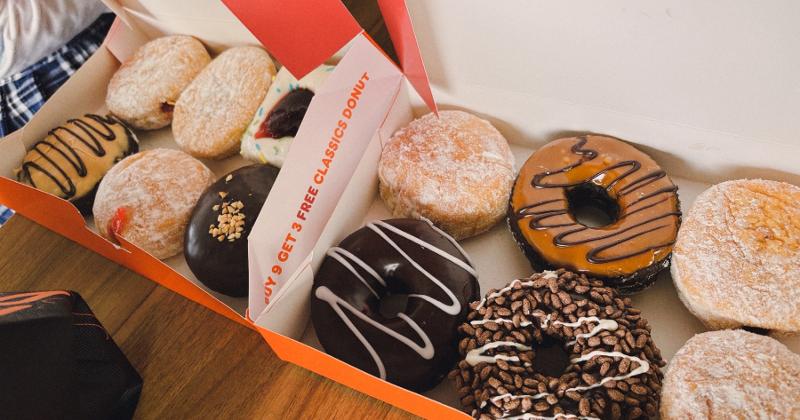
Dunkin’ has 16 doughnut varieties that franchisees are required to offer every day. Part of the manager’s job is to decide how many of each they should stock.
Picking the right mix is not easy. Demand can fluctuate from day to day. On weekends, parents come in with their sprinkle-loving kids. During the week, commuters tend to avoid anything with powder. Holidays, school schedules and weather can throw a wrench into the usual patterns.
“Depending on what the customers do that day, they might follow those varieties you have,” said Margo Hughes, executive director of business services for Bluemont Group, a Dunkin' franchisee based in Knoxville, Tennessee.
But also, “they might buy all your glazed doughnuts by 8 o’clock in the morning, and then for the rest of the day you’re just out of that variety.”
What makes this all the more challenging is that Dunkin' managers can’t fully rely on past sales to make their predictions, because individual doughnut varieties aren’t always rung into the POS, like when a customer buys an assortment or a prepackaged box.
Stores do count the doughnuts left over at the end of the day, which would allow them to measure what they’ve sold, but those counts aren’t always precise either. Employees sometimes estimate or forget to count.
That means managers are often left to make educated guesses about what to order for the next day. And when they guess wrong, they have to throw away the unsold doughnuts.
At Bluemont, which operates 99 Dunkin's in seven states, that waste was adding up to about $3.1 million a year.
Hughes was on the lookout for ways to bring that number down when she came across an article about AI-powered cameras being used to identify pastries in Japan. A lightbulb went on: If Bluemont could use cameras to track exactly what doughnuts people were buying, it could get a better idea of what to stock, allowing it to cut down on leftovers.
Hughes began talking to different AI suppliers. One of the companies she met with was PreciTaste, which had already been using its AI vision product to identify different breads. It could tell a roll from a croissant and a croissant from a pretzel.
“I was like, if they can do that, truly they can identify doughnuts,” Hughes said.
In the spring of 2024, Bluemont began working with PreciTaste to develop Do’Cast, a doughnut tracking and forecasting system that is now used by all 99 of the group’s stores.
It is one of a growing number of restaurants that are exploring how AI and computer vision can help them collect data on their operations, such as drive-thru wait times, inventory and order accuracy. Dunkin’ competitor Starbucks last year launched a new stock-keeping system in which employees use AI-powered tablets to scan and count inventory.
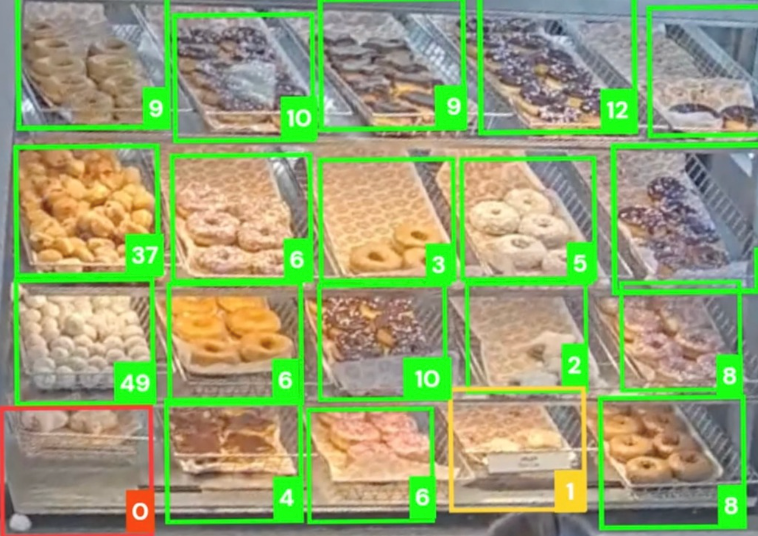
Do'Cast keeps track of how many of each doughnut variety are sold. | Photo courtesy of PreciTaste
For Bluemont, the first step was to install three or four cameras in a test location to “see what we can see,” said Charlie Pynnonen, senior engineer for PreciTaste. “Whatever the camera can see, the AI can theoretically count,” he said, “but only if we have good visibility of the cases and the doughnuts as they’re wasted.”
Once that was done, PreciTaste could start training the AI how to identify different doughnuts. Pynnonen compared this process to solving an online captcha puzzle. The AI would be instructed to select all of the strawberry-sprinkled doughnuts in a set, for instance. A human supervisor would check its work and, over time, it would improve.
Some doughnuts were challenging, like identical powdered doughnuts with two different creme fillings. (One of those has since been discontinued.) Dunkin' also offers seasonal doughnuts, such as heart-shaped Valentine’s Day varieties, that require additional training. Labels on each doughnut basket can act as a backup if the AI gets confused.
The bulk of the training took about six months, and it is ongoing, with some human involvement. Every day, a team of PreciTaste labelers checks the mix of leftover doughnuts at each Bluemont store and then compares it against the AI’s count, manually correcting any discrepancies so the system can learn from its mistakes.
Counting doughnuts is just the first step of what Do’Cast is ultimately designed to do. The count creates a more accurate record of sales. The AI can then use that to generate a doughnut order for each day, also factoring in variables such as past sales, weather and other local effects. Then it automatically places an order with Dunkin's central bakery each night.
This has taken some work off managers’ plates. But it also means that they no longer control their doughnut supply, a change that has gotten mixed reviews. Average managers are happy to hand over that responsibility, Hughes said, but more experienced ones miss being able to fine-tune their selection.
“Those managers want to have the ability to say, every day, this guy comes in and looks for his lemon doughnut, and gets mad, real mad, that his doughnut’s not available,” Hughes said. “And that’s really hard, because they’re the ones who have to face that guest. … And it’s much easier for me to say $5 of waste is not worth the $2 that you did in sales to make that one guest happy.”
Do’Cast does not have carte blanche over the doughnut mix. Bluemont has put some hard rules in place, such as that stores are never allowed to run out of glazed, its most popular doughnut.
And of the 16 required varieties, six or seven account for about 65% of sales, which makes forecasting a little easier—though there can be regional differences.
In Chattanooga, for instance, customers prefer richer flavors, like chocolate frosting or cream filling. “We have managers down there that are like, ‘I can’t sell enough of these Creme Delights,’ but you can’t apply that to any other region,” Pynnonen said.
The Do’Cast can make puzzling decisions at times. It has a habit of ordering far more double chocolate doughnuts than needed, for instance. And it’s not always easy to determine why. “It’s this mysterious black box that doesn’t tell us its reasons for doing things,” Hughes said.
These anomalies can be frustrating for managers and customers. To ease their concerns, Hughes has been comparing the AI to a puppy. When a puppy jumps on you, she said, “he doesn’t know that that’s wrong until I’ve told him that’s wrong, and there’s been consequences, and there’s been praise for doing it correctly, and that all takes time.
“But I think the thing that makes it also happy is that I know this will be the right thing in the end.”
Indeed, despite some growing pains, Do’Cast has proven effective at reducing waste over the long haul. In 2025, Bluemont’s doughnut waste was down 25% year over year, and it continues to improve every month. The company is hoping to eventually cut waste in half, to $1.5 million a year.
Not only that, but Do’Cast is also helping stores lower their labor costs. Managers no longer have to place orders and employees no longer have to count doughnuts at the end of the night, which saves about an hour to 90 minutes of work each day, Hughes said.
These savings are more than covering the cost of the technology, which pays for itself within the first couple of dollars it saves every day.
The technology has caught the attention of several other Dunkin' operators, a couple of which have already signed up to use Do’Cast in their stores.
“It’s expensive to develop a new AI product,” Hughes said. “But if we create a successful product that works for Bluemont, that will very likely work for other franchisees. So there’s an upside to investing in the tech.”
